
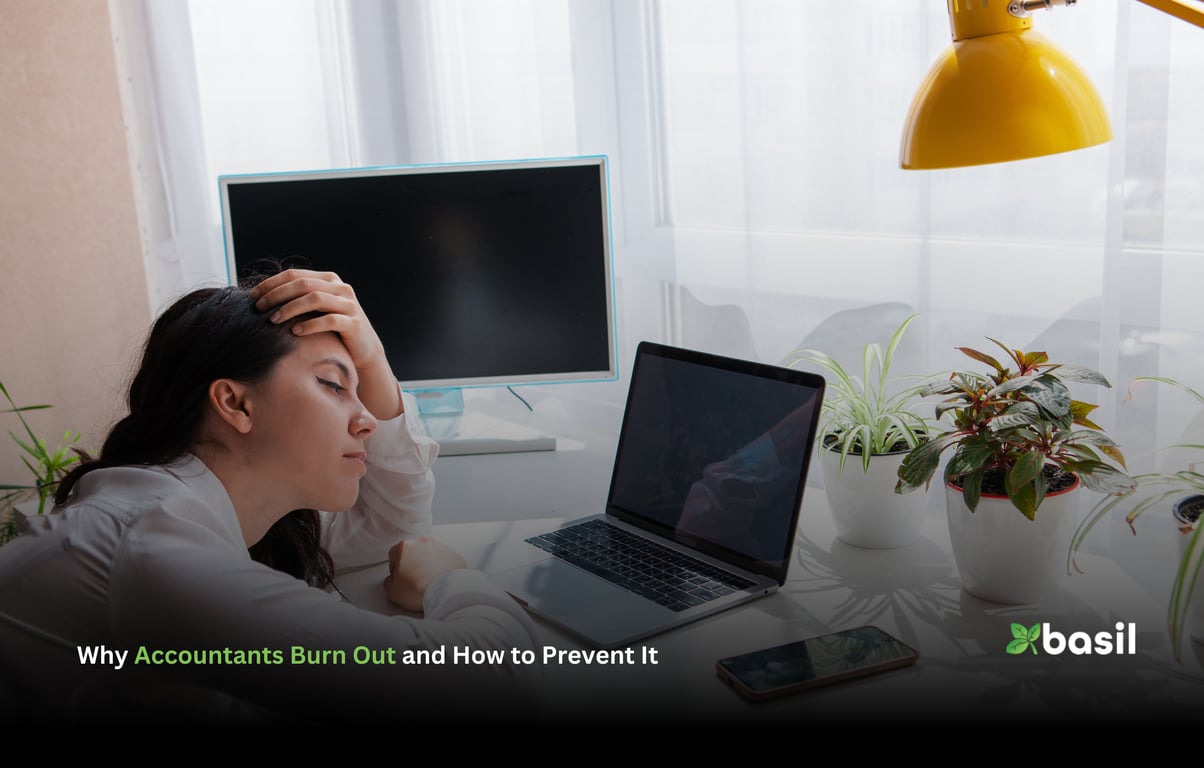
Why Accountants Burn Out and How to Prevent It
Contents
Accounting is one of the most demanding professions in the world.
Strict deadlines. Complex regulations. Clients who need answers fast. A workload that spikes sharply during tax season and barely slows down the rest of the year. And underneath all of that, the constant pressure to be accurate — because in accounting, mistakes have real consequences.
It is no surprise that accountant burnout is one of the most talked-about challenges in the profession today. Research consistently shows that accounting professionals experience high rates of workplace stress, and many leave the profession entirely within the first few years of their career.
But burnout is not inevitable. It is predictable. And when you understand what causes it, you can take practical steps to prevent it — both for yourself and for your team.
This blog walks through the real causes of accountant burnout, the warning signs to watch for, and the specific strategies that help accounting firms build a sustainable, healthier way of working.
What Is Accountant Burnout?
Burnout is a state of chronic stress that leads to physical and emotional exhaustion, a growing sense of detachment from your work, and a feeling that nothing you do makes a difference.
For accountants, burnout does not usually arrive suddenly. It builds over time — through too many late nights during tax season, too many hours spent on admin work instead of meaningful client work, too many deadlines managed through sheer willpower with no real system to support them.
When burnout takes hold, it affects everything. Work quality drops. Errors increase. Relationships with clients and colleagues become strained. And talented, skilled accounting professionals start looking for the exit — either to a different firm or out of the profession entirely.
The good news is that most of the conditions that lead to accountant burnout are preventable when you address them directly — with better systems, better boundaries, and better tools.
Why Accountants Are Especially Vulnerable to Burnout
Several factors make the accounting profession particularly prone to burnout.
High-stakes accuracy requirements. In accounting, errors are not just embarrassing — they can cost clients money, trigger penalties, and damage your firm's reputation. That constant pressure to get everything right takes a psychological toll over time.
Seasonal workload spikes. Tax season compresses an enormous volume of work into a narrow window. Many accounting professionals work significantly longer hours during this period — for weeks or months at a stretch. Recovering from that level of sustained pressure takes time, and many firms do not build enough recovery time into their annual cycle. As explored in navigating tax season challenges — strategies for accounting firms, the firms that manage tax season best are the ones that plan for it systematically — not the ones that simply push their team harder.
Admin overload. Many accountants spend a significant portion of their week on tasks that are not actual accounting work — chasing documents, sending follow-up emails, recreating task lists, and switching between tools. That kind of low-value, repetitive work is deeply draining and one of the leading contributors to accounting work stress.
Unclear boundaries. Clients expect fast responses. Deadlines do not negotiate. And in a profession where your clients' financial wellbeing depends on your work, it can feel impossible to switch off. Without clear professional boundaries, accountants end up always available — and always depleted.
The 6 Main Causes of Burnout in Accounting Firms
Understanding the specific causes of accountant burnout in your firm is the first step toward preventing it.
1. Unmanageable workloads. When the volume of work consistently exceeds what the team can reasonably complete in normal hours, sustained overwork becomes the norm — and burnout follows. This is especially acute in small firms where one or two people carry the weight of many client engagements simultaneously.
2. Lack of systems and processes. When every engagement requires building from scratch — recreating task lists, chasing documents, tracking deadlines manually — the invisible overhead of just managing the work becomes exhausting. Systems that should reduce effort end up creating more of it. Addressing this directly through accounting workflow management software removes the structural friction that amplifies workload pressure.
3. Too many admin tasks. Non-billable, repetitive admin work — document chasing, manual billing, status updates, tool switching — drains energy without producing value. Accountants who spend large parts of their day on these tasks feel underused and frustrated, even when they are technically busy.
4. Poor visibility and unclear priorities. When nobody has a clear picture of what needs to happen, who is doing it, and when it is due, teams operate in a constant reactive mode. That reactive pressure — never quite knowing what is coming next — is one of the most exhausting ways to work.
5. Isolation and lack of support. Solo CPAs and small firm accountants often work with little structural support. When everything falls on one or two people, there is no buffer when something unexpected happens. And when there is no system for delegation, every problem becomes a personal one.
6. Technology that creates more work. When accountants use five or six disconnected tools to manage one client engagement, they spend time managing their tools instead of managing their work. That technology friction quietly adds hours to every week and frustration to every day. As covered in why accounting firms lose time on admin work, the firms that reduce tool sprawl consistently report lower stress levels and better team satisfaction.
Warning Signs of Accountant Burnout
Recognizing burnout early gives you the best chance of addressing it before it becomes serious. Watch for these signs in yourself and your team.
Persistent exhaustion that does not improve with rest. If you or a team member feels tired even after a weekend or a short break, that is a signal that the fatigue goes deeper than normal tiredness.
Declining quality of work. More errors than usual, missed steps, and deliverables that do not meet your usual standard. Burnout directly affects concentration and attention to detail — two things accountants cannot afford to lose.
Growing detachment from clients and colleagues. When someone who was previously engaged and responsive starts withdrawing — fewer conversations, shorter responses, less initiative — that detachment is a classic sign of burnout taking hold.
Cynicism about the work. Feeling like nothing you do matters, that clients do not appreciate the effort, or that the firm does not see your contribution. These feelings are not simply bad attitudes — they are symptoms of a depleted person.
Increased absenteeism. Sick days, late starts, and a general reluctance to engage with work often signal that someone is running on empty.
If you notice these signs, the response is not to push harder. It is to reduce pressure — through better systems, clearer boundaries, and more sustainable ways of working.
How to Prevent Accountant Burnout — 7 Practical Strategies
Preventing burnout requires changes at both the individual and firm level. Here are seven strategies that make a real difference.
Strategy 1 — Standardize Your Workflows
When every engagement starts with a complete, pre-built task list instead of a blank page, your team spends less energy on coordination and more on actual work. Workflow templates remove the cognitive load of figuring out what to do next — which is surprisingly draining over time. For a complete look at how to build these, see why your accounting firm needs workflow management software.
Strategy 2 — Automate Repetitive Admin Tasks
Document reminders, recurring task creation, invoice generation — these are tasks that follow a predictable pattern and do not require human judgment. Automating them removes a meaningful chunk of the daily admin burden and gives your team back hours every week.
Strategy 3 — Set Clear Boundaries Around Working Hours
Especially during tax season, boundaries matter. Define your firm's standard hours. Communicate response time expectations to clients. Build structured recovery time after peak periods into your annual plan. Sustainable firms protect their team's time — not just their billable hours.
Strategy 4 — Track Workload Distribution Across the Team
When one or two team members consistently carry more than their share, burnout becomes inevitable. Regular visibility into who has what — through a shared task dashboard — lets managers redistribute work before someone hits a wall. This connects directly to capacity planning for accounting firms, where proactive workload management prevents the spikes that lead to sustained overwork.
Strategy 5 — Reduce Tool Switching
Every time a team member switches between platforms to complete one piece of work, they lose time and mental energy. Consolidating your tools into one platform — where tasks, documents, communication, and billing all live together — reduces the daily friction that quietly drains your team.
Strategy 6 — Give Your Team Visibility
Uncertainty is exhausting. When team members do not know what is expected of them, what the priorities are, or how close they are to a deadline, they operate in a state of low-grade anxiety that wears them down. A clear, shared task system removes that uncertainty. Everyone knows what they are doing, when it is due, and what comes next.
Strategy 7 — Build Recovery Into Your Annual Calendar
Tax season ends. Year-end close ends. Build dedicated lighter periods into your firm's calendar — weeks where client-facing deadlines are minimized and the team can catch up, reflect, and recharge. Firms that plan for recovery prevent the compounding exhaustion that leads to burnout over time. See navigating the busy season — work-life balance for accountants for practical strategies to manage the intensity of peak periods without burning out your team.
How Basil Helps Accounting Firms Prevent Burnout
Most of the strategies above require one thing: a platform that supports them. Basil is refreshingly simple accounting practice management software built for CPAs, bookkeepers, and small accounting firms — and every feature directly addresses one of the root causes of accountant burnout.
Task Management and Workflow Templates
Every engagement starts with a complete task list — automatically created from a template, assigned to the right person, with the right due dates. No rebuilding from scratch. No wondering what comes next. Your team starts every engagement organized — without spending mental energy getting there.
Workflow Automation and Recurring Tasks
Document requests, task creation, invoice generation — Basil handles the repetitive coordination steps automatically. Your team focuses on accounting work while the admin runs in the background. Non-billable hours drop. Actual work time increases.
Dashboard and Reporting
Managers see workload distribution across the whole team from one dashboard. When someone is carrying too much, it is visible before they reach their limit. Proactive workload management becomes possible — and team wellbeing improves as a result.
Document Management and Client Portal
Clients upload documents through their secure portal. Files land in the right place automatically. The document-chasing cycle that drains hours every week disappears. Your team gets back the time they were spending on follow-up emails and inbox searches.
Time Tracking
Track billable hours by client and project inside Basil. When billing time comes, invoices generate from your time logs — no manual reconstruction, no missed hours. Your team gets paid accurately for the work they do, without additional admin effort at the end of every period. See how time tracking software helps accountants manage workloads during tax season — and why accurate time logging reduces stress as much as it improves revenue.
Built-In Chat and Email Integration
Team communication stays tied to the right client and task inside Basil. No hunting through messaging apps for context. No important decisions lost in personal inboxes. Your team spends less time managing communication and more time doing the work.
CRM
Every client record, communication history, and engagement note lives in one organized place. When a team member picks up a client file, they have full context immediately — no asking around, no reconstructing what happened last month. Handoffs are smooth. The cognitive load of keeping track of every client detail is shared by the system, not carried by the individual.
Conclusion
Accountant burnout is real, widespread, and damaging — to individuals, to teams, and to the firms that rely on them. But it is not inevitable.
The causes of burnout in accounting are predictable: unmanageable workloads, too much admin work, poor systems, unclear priorities, and technology that creates more friction than it removes. Every one of those causes has a practical fix.
Better workflow systems remove the daily friction that drains your team. Clearer task visibility removes the anxiety of not knowing what comes next. Automation removes the repetitive admin that makes skilled accountants feel underused. And a platform that connects everything — instead of scattering it across five tools — removes the exhausting overhead of managing the infrastructure around the work.
Your team's wellbeing is not separate from how well your firm runs. It is the foundation of it. Protect it with the right systems — and let Basil handle the rest.